


9 Times the Villain Was Right (And the Heroes Were Just Loud)
Let’s face it — some villains make better arguments than the heroes do speeches.Sure, they swing too hard, cross too many lines, and occasionally turn an ethics debate into mass destruction, but deep down, you can’t deny that little voice whispering, “He’s got a point.”
Hollywood likes its morality color-coded: heroes noble, villains nuts. But if you rewind the reel with your eyes open, you’ll see something else — desperation, conviction, even reason. Sometimes heroes just have better lighting.
So grab your popcorn and your moral ambiguity — Pappy’s about to praise the people you were told to boo.
1. Frankenstein’s Monster — “Frankenstein” (1931)

The poor guy never asked to be born, never wanted fame, and definitely didn’t request to be stitched together like a patchwork corpse quilt. Yet the moment he blinks into existence, his maker screams, villagers grab torches, and everyone decides he’s the problem.
The tragedy of Frankenstein’s monster isn’t that he’s evil — it’s that he’s lonely. He reaches for light, and the world answers with fire. Every act of violence is retaliation, every roar an echo of rejection. He’s what happens when humanity’s ego outpaces its empathy.
Dr. Frankenstein made a miracle and then disowned it, leaving his creation to fend for itself in a world allergic to difference. If there’s a sin in this story, it’s cowardice — not creation.
In the end, the monster becomes the scapegoat for mankind’s guilt. We burn the creature so we don’t have to face the mirror. He didn’t need pitchforks — he needed parents.
2. Carrie White — “Carrie” (1976)

Carrie was a teenage girl with a problem — a school full of sociopaths and a mother straight out of a horror film herself. For most of the movie, she’s the victim: bullied, mocked, gaslit, and humiliated for simply existing.
When she finally gets a taste of acceptance, her classmates dump pig’s blood on her like cruelty’s closing statement. And then — blessed be — she snaps. The gymnasium turns into a temple of karmic combustion, and for the first time, Carrie isn’t crying. She’s seen.
Was she excessive? Sure. Fire, telekinesis, mass murder — maybe a touch overboard. But her rage isn’t monstrous; it’s proportional. It’s the universe collecting on decades of unpaid emotional rent. Carrie didn’t become evil — she became inevitable. And honestly, if my prom went like that, I’d burn the DJ booth too.
Sometimes revenge isn’t right — it’s righteous.
3. The Blair Witch — “The Blair Witch Project” (1999)

Every October, tourists wander into cursed forests and act shocked when the local spirit files a grievance. The Blair Witch never asked for fame; she just wanted her woods left alone. Instead, three film students show up with microphones, mock her legend, and turn her home into a content farm.
And what does she do? Practically nothing. She lets them lose themselves — geographically, mentally, morally. They spiral into paranoia without her ever needing to appear. She’s the queen of passive-aggressive haunting.
The genius of the Blair Witch isn’t that she kills — it’s that she waits. She doesn’t hunt them; she exposes them. Their fear does the rest.
In a world where we monetize every myth and hashtag every horror, maybe she’s not a monster — maybe she’s quality control. Respect nature. Respect folklore. And if you hear twig noises at 3 a.m., apologize — loudly.
4. Killmonger — “Black Panther” (2018)
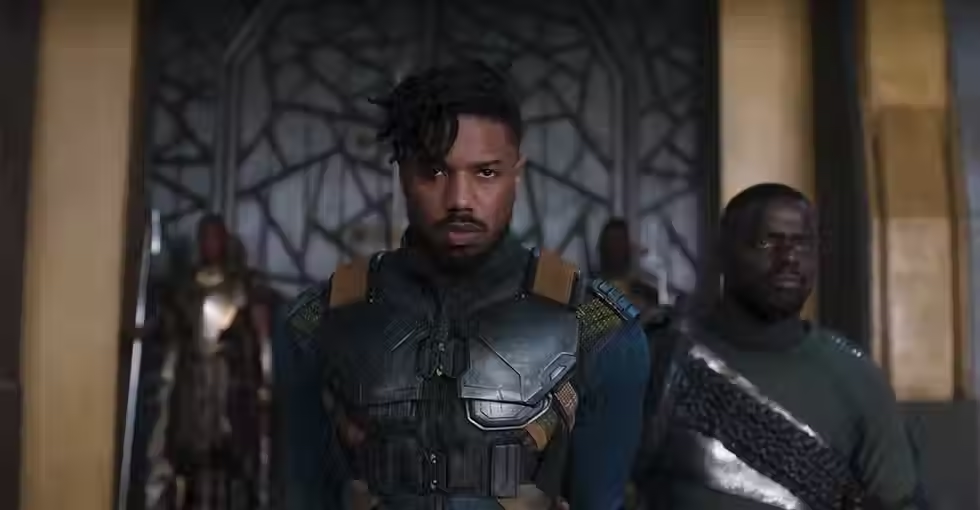
Every great villain thinks he’s saving the world. Killmonger might have been the first to actually try.
Raised outside the utopia that could’ve saved him, he grows into a revolutionary forged by exile. He doesn’t want to destroy Wakanda; he wants it to fulfill its promise — to stop hiding and start helping. His tragedy isn’t ambition — it’s trauma weaponized.
His argument is flawless: if your nation can heal the oppressed but chooses silence, you’re complicit. What makes Killmonger compelling is that he forces the hero to evolve. T’Challa ends the movie not by defeating him, but by agreeing with him — and adjusting Wakanda’s future accordingly.
Killmonger’s downfall wasn’t ideology; it was method. He tried to free the world by mirroring its violence. But he died on his feet, unbowed, whispering a line too raw for any cape movie before or since: “Bury me in the ocean…”
He wasn’t wrong. Just early.
5. Candyman — “Candyman” (1992 / 2021)

Say his name five times and you summon a ghost — but really, you’re summoning history.
Candyman isn’t a monster in the slasher sense; he’s a symptom. Born from injustice, sustained by forgetting, he’s what happens when society buries its sins under gentrified condos and then acts surprised when the past claws back through the drywall.
In both versions, his violence has purpose. He punishes denial, forces remembrance, demands acknowledgement. He’s folklore’s revenge for selective memory — a myth that turns complacency into consequence.
Every scream is a headline we ignored. Every death, a footnote in an American horror story written in red and erased in white. Candyman doesn’t haunt; he teaches.
Don't speak on anyone you don't want a problem with.
6. Norman Bates — “Psycho” (1960)

Norman’s not right about everything — but he’s right about one thing: repression will rot you from the inside out. The man’s life is a masterclass in denial. Trapped under the thumb of a mother who’s long dead yet ever-present, Norman becomes both victim and vessel. He’s not plotting; he’s coping. The shower scene isn’t a statement of power — it’s the sound of a psyche cracking.
Hitchcock didn’t make a movie about madness — he made one about loneliness. Norman is the American ideal of politeness curdled into pathology. He smiles, he stammers, he cleans up — and when the mask slips, you realize the monster isn’t inhuman. It’s heartbreak turned inward.
Therapy could’ve saved a lot of towels.
7. Thanos — “Avengers: Infinity War” (2018)

The purple philosopher himself. Half cosmic warlord, half environmentalist with an extinction kink.
Look, he’s wrong in practice — genocide is generally bad PR — but conceptually? The guy spotted the cracks in the universe and decided to act. Overpopulation, resource scarcity, imbalance — all things the heroes ignore while flying around in billion-dollar suits. Thanos doesn’t hate life; he fears what it’s becoming.
What makes him compelling is his conviction. He cries for what he destroys. He mourns the price of his own logic. He’s a zealot, yes, but a thoughtful one. And when the dust settles — literally — you realize the Avengers never disproved his theory; they just hated his math.
Wrong equation, right concern. Someone get this man a sustainability grant.
8. The Machines — “The Matrix” (1999)

The machines didn’t enslave humanity out of malice — they did it out of necessity. Humans scorched the sky, wiped out ecosystems, and then had the nerve to act shocked when AI built a battery farm for survival.
The Matrix isn’t a prison; it’s a peace treaty. Humanity gets comfort and illusion; the machines get energy and quiet. The only ones complaining are the unplugged — the folks who miss real steak but not real consequences.
When you think about it, the machines gave humanity mercy. A world without war, hunger, or Twitter. Sure, it’s fake — but so’s most of what we call “real” anyway. Before you call your captor evil, make sure you didn’t program them yourself.
9. Regina George — “Mean Girls” (2004)

Call her petty, call her cruel — I call her accurate.
Regina isn’t a villain; she’s capitalism with lip gloss. She runs high school like a corporation: manipulative, image-obsessed, ruthless, and deeply efficient. Everyone hates her power until they inherit it. The moment she’s dethroned, the entire ecosystem crumbles — not because she was toxic, but because she was the only one honest enough to admit it.
Her brilliance lies in clarity. Regina never pretends to be “nice.” She weaponizes transparency. Her rules are stupid, yes — but everyone follows them anyway. That’s not evil; that’s management.
In a world built on popularity contests, the queen bee’s just better at the game.
Villains are just protagonists who ran out of patience. They see the system, call it broken, and get condemned for trying to fix it without permission. And sure — they burn bridges, cities, sometimes universes. But every hero’s speech about justice usually starts with the villain’s thesis statement.
This Halloween, when the bad guy steps on screen, don’t just hiss. Listen. You might hear the truth — whispered through the dark by someone Hollywood told you to fear.
Stay kind, stay curious, and don’t spill the butter on your way out.— Pappy Hull, The Popcorn Philosopher


Comments