


Film Review: Highest 2 Lowest (6.5/10)
Views From The Penthouse
When a master craftsman like Spike Lee teams up with an industry pillar like Denzel Washington for their fifth collaboration—a reimagining of Akira Kurosawa’s foundational 1963 police procedural, High and Low—the conversation focuses entirely on the precision of the execution. Lee's new crime drama, Highest 2 Lowest, stands as a triumph of technical labor, marking a significant return to the director's roots after nearly twenty years since their last project, Inside Man. This latest "joint" translates Kurosawa's intricate visual language into a modern, tech-driven landscape where music moguls and influencers collide.
Despite a limited initial theatrical window that saw a modest $1.5 million at the box office due to commercial constraints, the film's one-night-only theatrical re-release on Saturday, December 6, serves as a vital reclamation of the cinematic experience it was engineered for. Starring Washington alongside Jeffrey Wright, Ilfenesh Hadera, and A$AP Rocky, the story follows David King, a powerful music executive who faces an impossible moral choice when his chauffeur’s son is kidnapped in a case of mistaken identity.

STORY (1/2)
The story is a unique mixed bag of moral claustrophobia, successfully transplanting Kurosawa’s Yokohama noir into the humid, rhythmic, and often terrifying chaos of modern Manhattan. The uniqueness of the narrative lies in its refusal to be a simple "ticking clock" thriller, opting instead to dissect the jagged glass of class, legacy, and the specific pressures of the Black elite in 2025. David King has mortgaged his entire swanky lifestyle and his very soul to regain his artistic independence from corporate vultures, only for a random act of criminal incompetence to force him into a devastating choice. Should he pay a $17.5 million ransom—effectively losing his business and his future—to save a child who isn't even his own? The setting of the music industry impacts the story perfectly, replacing the industrial shoe factory of the original with the equally cutthroat and ego-driven world of "Stackin' Hits Records."
Lee’s team faced the immense labor of transposing an intricate visual and structural foundation onto this contemporary canvas, and they succeeded by making every beat feel urgent and authentic. The plot is complex enough to keep your brain firing but easy enough to follow because the emotional stakes are so primal and the "high vs. low" metaphor is so effectively visualized. What makes this story distinct is the way Spike Lee injects a sense of sociological weight into the procedural elements, particularly how the legal system and the media treat the "King" in the penthouse versus the "Nobody" driver in the basement. The pacing in the first half is remarkably deliberate, almost static, trapping us in that luxury apartment until the air feels thin. Once the ransom is paid on a crowded subway train during a chaotic Puerto Rican Day parade, the story explodes into the streets of New York. It is an engaging, unflinching look at whether we actually possess the humanity we claim to have when the bill for that humanity finally comes due. By the time the credits roll, the story has evolved from a crime thriller into a profound meditation on the price of a soul in a world that values everything in dollars and cents.

VISUALS (1.5/2)
Cinematographer Matthew Libatique has done something truly special here, creating a visual language that mirrors the title's literal and metaphorical heights with breathtaking clarity. The picture quality is exactly what you expect from a Spike Lee joint: vibrant, sharp, and obsessed with the geometric architecture of New York City. There were no distracting issues with visual quality; in fact, the film uses different stocks and lighting textures to differentiate the sterile, air-conditioned luxury of the penthouse from the sweaty, crowded reality of the street. The color style is impactful, moving from the cool, detached blues of the high-rise to the warm, chaotic oranges and reds of the city at ground level, effectively highlighting the moral distance between the two worlds. Lee’s team utilized fixed camera placements and deep focus to build dread, a direct and respectful nod to Kurosawa’s original masterclass in spatial choreography.
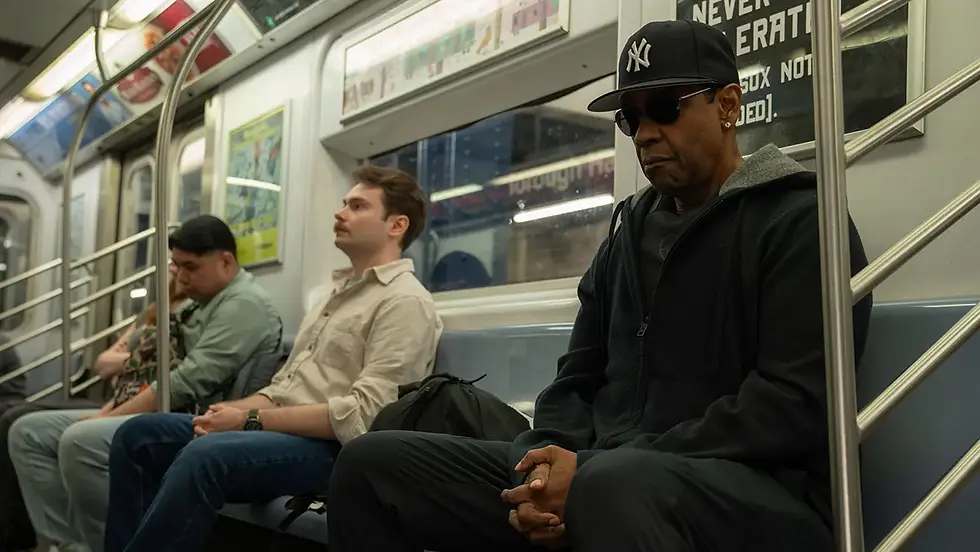
I was absolutely stunned by the subway ransom sequence, where the visual scale of a crowded train car becomes a frantic, neon-blurred race against time that feels almost hallucinatory. The use of wide frames in David King's abode is a stroke of genius, making the wealth feel vast and yet oddly empty, like a museum where the inhabitant is just another artifact. It highlights how the art and memorabilia—some of it reportedly from Spike’s own legendary collection—act as a fortress against the world outside. The film’s aesthetic is a love letter to NYC sports and music, with every frame feeling like it was curated by someone who breathes the city's air. From the gaffer’s delicate touch in lighting the contained, apartment-bound scenes to the art department’s commitment to setting the scene, the craft truly shines. Seeing this on a large screen is the only way to appreciate the technical design, where the deliberate visual contrasts and the meticulous placement of actors in the frame create a sense of mounting thematic pressure. It is a visual triumph that proves Spike Lee is still one of the most precise directors working today.

SOUND (1/2)
The audio mix is where the film's "art vs. commerce" struggle is most audible, especially if you were forced to watch it on a tablet during its initial streaming-only window. The balance between the classical, somber score and the sudden, rhythmic eruptions of James Brown tracks is a bold choice that largely pays off in a theatrical setting. The music score definitely compliments the emotion, moving from the hubris of the morning sun to the "sweaty" intensity of the second-half manhunt, effectively keeping the audience's pulse racing. There were a few moments where the dialogue felt slightly buried under the urban cacophony of the parade or the clatter of the subway, which might be a loss for some viewers. This sound mix, which layers dialogue, score, and ambient city noise to build tension, is unfortunately flattened when played through consumer speakers, losing the depth that the below-the-line crew worked so hard to engineer.
However, when the sound is firing on all cylinders in a theater, it is immersive and purposeful, providing a sonic heartbeat for the entire production. The surround sound mix is a massive benefit during the subway scenes, where the rhythmic chanting of fans and the screech of the tracks create a wall of noise that heightens the protagonist’s panic. The sound design is critical for this crime thriller, and while it is highly precise, its effectiveness is intrinsically tied to the quality of the playback system. It only misses a perfect score because the transition from the sterile "Muzak" of the early scenes to the bombast of the finale can feel a bit jarring and imbalanced for those without high-end audio setups. The sound work acts as a heartbeat for the film, pushing the audience forward even when the pacing slows to a crawl, and it deserves to be heard in a room that can handle its frequency range. It’s a sonic environment that is as loud and demanding as the city it depicts.
CHARACTER (1.5/2)
This is the fifth time Denzel and Spike have teamed up, and they play each other like a finely tuned instrument, delivering a performance that is both commanding and deeply vulnerable. Denzel Washington gives one of his best recent performances as David King; he isn't playing a simple hero, he's playing a man who has built a reputation on having the "best ears in the business" but might be deaf to his own privilege. He moves with a rangy grace that slowly crumbles into a desperate, street-level vulnerability as the reality of the kidnapping sets in. Jeffrey Wright is equally heartbreaking as Paul, the driver who has to beg his "oldest friend" to value a child’s life over a corporate stock buyout. Their shared history and the resulting tension move the story forward far more than any police investigation or high-tech gadget could.
The supporting cast is equally stacked, with A$AP Rocky providing a revelation as Yung Felon; he brings a scene-stealing, ferocious energy that represents the new generation eager to dethrone the old guard. The way costume and makeup differentiate the characters—from David’s impeccably tailored, razor-sharp suits to the gritty, lived-in look of the city’s underbelly—adds layers of silent storytelling to every interaction. I was genuinely shocked by how much space Lee gave to the supporting cast, allowing Aubrey Joseph and Ilfenesh Hadera to feel like fully realized people with their own stakes in the game. These characters aren't just moving the plot; they are impacting the very soul of the film through believable, emotionally honest performances. The character arcs, especially the collision between the music mogul and the kidnapper, provide a development path that is both shocking and inevitable. It is a masterclass in ensemble acting where every role, no matter how small, feels essential to the tapestry of the city.
FACTOR X (1.5/2)
The Factor X here is the undeniable, and frankly frustrating, clash between cinematic craft and commercial constraint. On one hand, you have a magnificent cinematic achievement that demands the largest screen possible to appreciate the spatial choreography and technical precision. On the other, you have a release strategy that initially shoved this widescreen epic into the tiny confines of a streaming app after only two weeks of theatrical play. This tension actually adds a layer of unintended meta-commentary to the film’s themes: just as David King is pressured to value metrics over humanity, the film was pressured to value subscriber numbers over the cinematic experience. A low box office return of $1.5 million is not a failure of the product, but a result of these executional constraints.
I loved the inclusion of the exclusive short film by Lee during the re-release; it rewards the audience for choosing the theater over convenience and centers the creator's vision. It reminds us that some films are engineered for a specific fidelity that a stream simply cannot contain, and that certain artistic visions are diminished when they are flattened for a mobile device. The film is blunt, a little messy, and altogether glorious—much like the city of New York and Spike Lee’s entire filmography. I dock a half-point only because the "commercial" side of the production occasionally peeks through in the pacing of the first hour, which feels tailored for a "skip intro" generation. Yet, the re-release proves that this film is a victory for artistry over product, and it serves as a valuable lesson that some cinematic craft cannot be contained by the size of a stream, only by the size of the screen. It is an act of respect for the art form that I hope more studios emulate.
Highest 2 Lowest is a testament to the fact that when you put people over product, you get something that refuses to be ignored. It’s a Spike Lee joint through and through: vibrant, idiosyncratic, and deeply in love with its flawed characters. While the industry tried to tuck it away into a streaming corner, its return to the big screen proves that certain stories need a massive canvas to breathe and a room full of strangers to truly resonate. You should absolutely catch the re-release if you can, as it represents a rare opportunity to see a master at work in his preferred environment. If you can't make it to the theater, at least invest in a decent soundbar and dim the lights before hitting play on Apple TV+. Because if you can laugh and still care about a music mogul’s soul in the middle of a subway chase; that’s cinema magic right there.
FINAL SCORE: 6.5/10
Where to Watch: Netflix

Help Us Keep The Lights On By Supporting Our Partners:

*This post contains affiliate links, and we may receive a commission if you make a purchase.


Comments