


Film Review: Shaun of the Dead (8/10)
A midnight movie that somehow became a mainstream classic without losing any of its bite.
Edgar Wright's Shaun of the Dead arrived in 2004 as a British horror comedy written by Wright and Simon Pegg, produced by Nira Park, and directed by Wright. The film stars Simon Pegg as Shaun, Nick Frost as Ed, Kate Ashfield as Liz, Penelope Wilton as Barbara, and Bill Nighy as Philip. It blends midnight-movie zombie gore with razor-sharp British wit and affectionate pop-culture fandom into something that should not cohere and somehow does.
The premise is a manchild electronics salesman who fails to notice the apocalypse because his entire life is already a shambling routine. What makes it work is its refusal to parody the genre. The zombies are played straight, the threat is genuine, and every joke lives in the gap between the end of the world and the stubborn normality of a North London weekend.
STORY (1.5/2)
The screenplay follows a twenty-nine-year-old salesman trapped in a routine so deadening that he barely registers the dead rising around him. He has a girlfriend he neglects, a stepfather he resents, and a best friend named Ed who has turned couch-surfing into a lifestyle. When the outbreak finally intrudes, Shaun's plan is not to save civilization. His plan is to rescue his mother and his ex-girlfriend and hole up in the Winchester, the same pub he visits every night of his life. The scale of the ambition is the joke, and it is a good one.
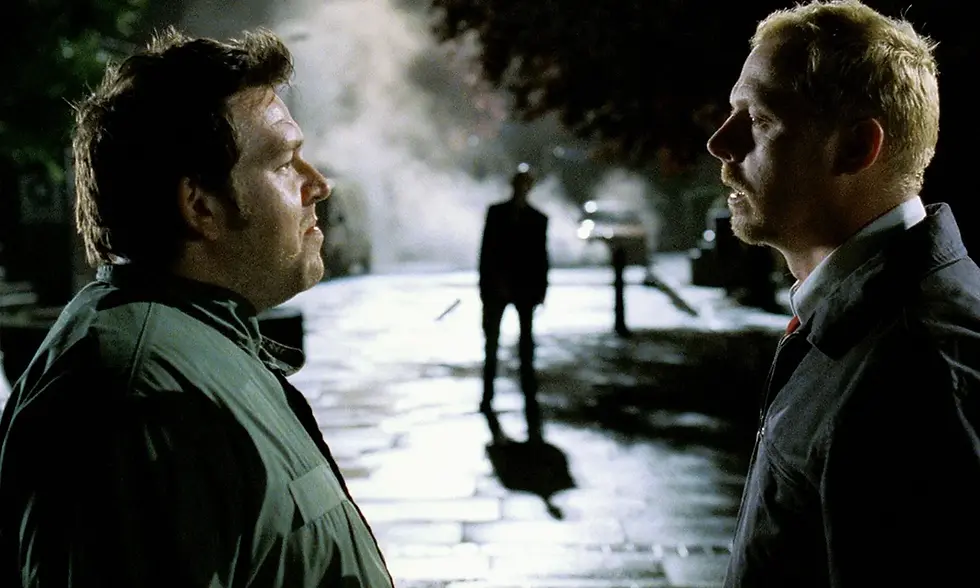
What elevates the story above sketch comedy is the discipline of its internal logic. The film treats the zombie outbreak with the same seriousness Romero brought to Pittsburgh, implying that Shaun and Ed exist in the same fictional universe as Dawn of the Dead. The comedy never comes from the zombies behaving foolishly. It comes from Shaun and Ed behaving foolishly while the zombies behave exactly as zombies should. That distinction is the difference between affection and mockery.
The romantic comedy scaffolding is not a gimmick. Liz dumps Shaun in the opening act because he is emotionally inert, and the zombie crisis becomes the forcing function that makes him finally act like an adult. The film earns its emotional beats because it commits to the relationship stakes before the gore arrives. When characters die, the deaths land with genuine weight even as the film finds humor in the surrounding chaos. **Full marks: yes, the structure holds from first scene to last with no slack.
VISUALS (2/2)
Wright directs the film like a music video veteran who has been waiting his whole life to stage a zombie kill. The visual grammar is dense with sight gags and foreshadowing, from the opening tracking shot that maps Shaun's daily routine to the mirrored composition later when he repeats that same walk through a devastated London. The editing is rhythmic and propulsive, cutting to the beat of jokes and scares alike. It looks better than most straight horror films of its era, with the gore and makeup effects holding up as genuinely convincing.
The garden sequence where Shaun and Ed dispatch their first zombies with vinyl records is a perfect distillation of the film's visual philosophy. The comedy is physical and escalating, but the blood is real and sticky, and the camera never winks at the audience. The scene works because the filmmakers treat a record to the skull as a legitimate tactic rather than a punchline. The tone shifts on a dime throughout the film, and the visuals hold that instability together.
The Winchester pub itself functions as the film's architectural thesis. It is a cramped, beige, thoroughly ordinary British boozer, and the film frames it as a fortress with the same reverence Romero reserved for shopping malls. The visual contrast between the pub's mundane interior and the carnage outside is the entire movie in miniature. It is a place worth surviving for, even if surviving means another pint at the same sticky table. **Full marks: yes, distinctive, coherent, and free of distracting weak spots.

SOUND (1/2)
The soundtrack is a character in its own right, and the jukebox gag is the film's most quoted flourish. The Winchester's jukebox, set to random, drops wildly inappropriate songs into moments of crisis, and the mismatch between Queen's "Don't Stop Me Now" and a zombie beating is genuinely inspired. The use of "You're My Best Friend" over the credits is a final, perfect joke about the film's real love story. But a handful of brilliant needle drops is not the same thing as a complete sonic identity.
The score by Daniel Mudford and Pete Woodhead is where the section loses a point. It leans heavily on the De Wolfe library cues that Romero used, which grounds the film in its lineage but also means the original musical voice is thinner than the rest of the production deserves. The mix itself is functional rather than distinctive, and there is little here that would stand alone outside the film. It serves the scenes without elevating them.
The sound design of the zombies is solid and the ambient dread in the early scenes is well judged. The contrast between an ordinary North London morning and the encroaching undead does quiet work before the chaos arrives. Still, this is a competent soundtrack rather than a revelatory one, and a full two points would be generous to a film whose audio personality is borrowed more often than it is invented. **Downgraded from 2. The full-marks question is originality of sonic identity, and this fails it.

CHARACTER (2/2)
Simon Pegg plays Shaun with a specific kind of British resignation that makes the character's eventual heroism feel earned rather than imposed. Shaun is not a secret badass. He is a man who has been drifting for years, and Pegg lets you see the self-awareness underneath the inertia. His transformation is not a power fantasy. It is a man finally deciding that something matters enough to fight for. The performance is funny and sad in equal measure, often in the same shot.
Nick Frost's Ed could have been an insufferable comic relief sidekick, and the fact that he is not is a testament to both the writing and the performance. Ed is crude, lazy, and profoundly loyal, and Frost plays him with a warmth that makes his worst behavior forgivable. The friendship between Ed and Shaun is the film's emotional core, and the ending, which keeps zombie Ed chained in the shed for PlayStation sessions, is both hilarious and oddly touching.
The supporting cast is stacked with British comedy talent, and each actor gets a moment to shine. Penelope Wilton brings genuine pathos to Shaun's mother, and Bill Nighy's stepfather is a masterpiece of passive-aggressive disappointment. Dylan Moran and Lucy Davis are underwritten as Liz's flatmates, and that thinness is the one soft spot in an otherwise lived-in ensemble. **Full marks: yes. I considered downgrading for the underwritten flatmates, but the ensemble question is about whether the cast carries the film, and Pegg, Frost, Wilton, and Nighy carry it emphatically.
FACTOR X (1.5/2)
The film's secret weapon is its understanding that zombies have always been a metaphor for the mindless routines of ordinary life. Shaun begins the film as a zombie in everything but biology, shuffling through the same commute, the same pub, the same conversations. The outbreak forces him to become alive precisely because the alternative is becoming literally undead. That thematic coherence is what separates Shaun of the Dead from lesser genre parodies. It has something to say, and it says it without ever stopping the jokes.

Where it loses a point is in originality of concept. The genre inversion is executed beautifully, but the underlying move, dropping a domestic comedy into a horror framework, is not unprecedented. An American Werewolf in London and Evil Dead II had already been circling this territory. That is a real achievement and not a reinvention. The film is a superb synthesis of existing ideas rather than a genuinely new one.
Shaun of the Dead remains the benchmark for what a genre mashup can achieve when it respects both halves of its equation. It is funny without being a parody, scary without being mean, and sentimental without being saccharine. Wright's direction is confident, Pegg and Frost are a perfect comic duo, and the script is tighter than most films half its age. For readers chasing the same energy, pair it with Hot Fuzz for the full Cornetto arc or Zombieland for the American answer to the same question.
It is a midnight movie that somehow became a mainstream classic without losing any of its bite. That is a high concept executed with precision, and it is still worth raising a pint to.
FINAL SCORE: 8/10
Where to Watch: Starz

Help Us Keep The Lights On By Supporting Our Partners:

*This post contains affiliate links, and we may receive a commission if you make a purchase.


Comments